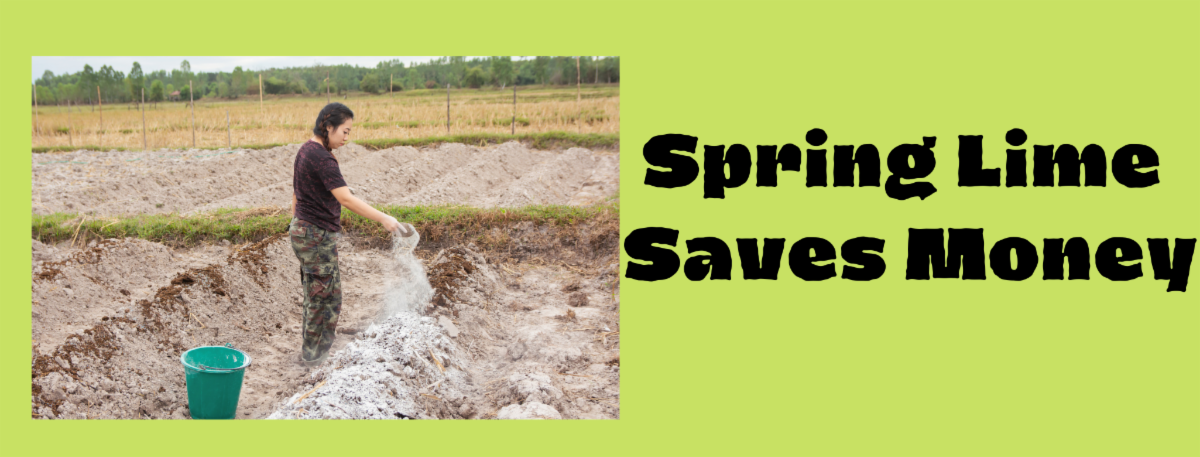
Why do you need to apply lime in the spring before plant growth? Lime can be produced from Calcium or Magnesium components and is categorized as Agricultural or Dolomitic. Agricultural limes are Calcium Carbonate based and are finer than Dolomitic lime. Often these limes will be treated with oxides or hydroxides to improve effectiveness. Dolomitic limes, in comparison, will be composed of Calcium and Magnesium . Lime will typically take 60-90 days to start adjusting your soil’s pH (potential Hydrogen) which is the basis for determining if a soil is acidic or alkaline. A soil’s pH range can be determined by conducting a soil test which is a service available through the N.C. Cooperative Extension, Mitchell County Center. Most plants grow on the acidic side of the pH scale at 5.5-6.5.
Determining a soil’s pH is crucial because it directly affects the nutrients available to one’s plants. A low pH has a negative effect on a plant’s ability to absorb nutrients. Think of it this way, if you drank orange juice all day eventually your stomach would become too acidic and your digestive system would fail to breakdown the nutrients properly. In comparison, if a gardener’s or farmer’s pH is too low and fertilizer is applied annually, the soil will continue to become more acidic and plant growth will decline. This is a waste of money spent on fertilizer because more fertilizer does not always equal better plant growth. Lime is used to correct this by raising a soil’s pH range back into levels where nutrients are readily available to plants. When conducting a soil test, one should secure test boxes provided by the N.C. Cooperative Extension, Mitchell County Center. One should then take random samples of the soil free of rocks, sticks, and other organic matter, label, and mail them to the address on the box for analysis. A soil report will be emailed to the client and provide recommendations to adjust and improve the soil. To get busy testing, apply your lime early to allow time for activation, which will save some money on fertilizer.