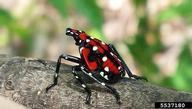
It was not a matter of if but a matter of when this unwelcome visitor would arrive. A little refresher on this insect invader, Spotted Lantern Fly (SLF) is a native of China, India, and South East Asia. SLF entered the United States via a shipment of Chinese landscape rock around 2014. Berks County, Pennsylvania (eastern portion of Pennsylvania) was the site of initial detection and identification. Since 2014 SLF has traveled to several additional states. Please see the attached map. The following is a list of SLF progression by state and year of detection: New Jersey (2018), Virginia (2018), Delaware (2019), West Virginia (2019), Maryland (2019), Connecticut (2019), New York (2020), Ohio (2020), Indiana (2021), and Massachusetts (2021). North Carolina is the latest state to identify an infestation of SLF on June 29, 2022 the North Carolina Department of Agriculture and Consumer service announced the discovery of SLF in Kernersville a suburb of Winston-Salem. Treatments and control measures are already underway in an effort to reduce SLF populations.
This expansion is a huge accomplishment for a plant hopper like SLF which are at best sub-par fliers in comparison to other insects. SLF relies on alien modes of transportation for travel such as vehicles, railroad cars, cargo, trailers, firewood, etc. it is suspected that SLF probably arrived in NC by rail. The grape industry has the most to lose in NC, because a vineyard infested with SLF can see reductions in yield of up to 90%. This insect does damage by piercing and sucking out plant nutrients and leaving behind frass (or honeydew) that molds or ferments which attracts wasps, ants, and other unwelcome guests. This infestation in regards to population numbers and the vast amount of frass generated greatly reduces photosynthetic activity thus weakening the plant which in turn leads to poor health and disease susceptibility. SLF feeds on fruit and native trees such as apples, plums, cherries, peaches, dogwoods, oaks, maples, and beeches. In fact, there are more than 100 species of plants that are susceptible to attack by SLF.